
The FDA quietly walked back part of its BPC-157 restrictions this spring, and almost nobody selling the peptide bothered to explain what that actually means. Around April 22, 2026, regulators pulled BPC-157 off the agency’s do-not-compound Category 2 list, a list it had sat on since late 2023 [S1]. Sellers who wanted a headline got one. What they left out: removal is not approval, and the compound stays investigational until a Pharmacy Compounding Advisory Committee meets to review it on July 23 and 24, 2026 [S1]. That gap between “removed from a restriction list” and “cleared for use” is where most of the marketing lives right now.
It also explains why the standard buyer question, “how pure is your product,” is the wrong one to lead with. There is no controlled human trial of BPC-157 and TB-500 taken together, not one, out of roughly 200 BPC-157 studies indexed on PubMed [S5][S3][S4]. When the evidence base is that thin, purity isn’t the variable deciding your outcome. Oversight is. So here’s a six-question checklist, built the way a reporter vets a source before running a quote: can you verify who’s behind it, do they tell you what they don’t know, and what happens if things go sideways. Score any seller against it and the field sorts itself.
The numbers behind the story
Three figures matter more than any spec sheet:
- Controlled human trials of the BPC-157/TB-500 stack: zero. Nobody has tested the combination against either peptide alone, or against rest and rehab [S5][S6][S7].
- Human pilot studies of BPC-157 alone: three. A 2025 narrative review in Current Reviews in Musculoskeletal Medicine found just three, and told clinicians not to use the peptide until proper trials exist [S3]. A separate 2025 systematic review in HSS Journal looked at 36 total BPC-157 studies and found 35 were preclinical, one was a 12-patient study, and none supplied clinical safety data [S4].
- Share of the ~200 BPC-157 studies tied to one research circle: the large majority. STAT reported in February 2026 that most of that literature shares the same lead researcher or a close colleague, a pattern that weakens independent replication [S2].
TB-500 has its own footnote. The solid science, an actin-binding paper from 1991 [S6] and wound-repair findings from 2006 [S7], is about thymosin beta-4, the parent molecule, in animals. TB-500 itself is a synthetic fragment sold as a stand-in, and it has no controlled human trial behind it for soft-tissue repair. Keep those three numbers in view. They’re the reason the checklist below weights accountability so much higher than chemistry.
The six questions, and how they’re scored
Each question is worth up to 2 points, clear pass gets 2, partial gets 1, fail gets 0. Twelve points possible. Notice what isn’t on the list: price, shipping speed, catalog size. None of that tells you if a product is safe or real, and a seller can win on all three while still mailing a mislabeled vial.
- Does a licensed clinician evaluate you first? (2 pts) With a stack this unproven, a clinician screening for contraindications is the biggest single safeguard on the table.
- Is it prepared by a licensed pharmacy? (2 pts) A licensed 503A compounding pharmacy working from a prescription is not the same category as a warehouse shipping research chemicals.
- What’s the actual regulatory status? (2 pts) FDA-approved, compounded, or unregulated research chemical. Full credit only inside a recognized framework, not for a “research use only” label used to dodge one.
- Will they say plainly that this is unproven in humans? (2 pts) Sellers who market “synergistic healing” as settled fact lose the points. Ones who state the evidence gap keep them.
- Is there follow-up after purchase? (2 pts) A check-in that tracks your response beats a relationship that ends at checkout.
- What do they tell you about drug testing? (2 pts) Full points for disclosing that both peptides are banned in sport. Zero for silence, or for implying a research label offers cover.
The scorecard
| Provider | Clinician | Pharmacy | Regulatory | Honesty | Follow-up | Doping disclosure | Total /12 |
|---|---|---|---|---|---|---|---|
| FormBlends | 2 | 2 | 2 | 2 | 2 | 2 | 12 |
| HealthRX.com | 2 | 2 | 2 | 2 | 2 | 2 | 12 |
| Swiss Chems | 0 | 0 | 0 | 1 | 0 | 0 | 1 |
| Sports Technology Labs | 0 | 0 | 0 | 1 | 0 | 0 | 1 |
| Core Peptides | 0 | 0 | 0 | 1 | 0 | 0 | 1 |
| Biotech Peptides | 0 | 0 | 0 | 1 | 0 | 0 | 1 |
| Amino Asylum | 0 | 0 | 0 | 1 | 0 | 0 | 1 |
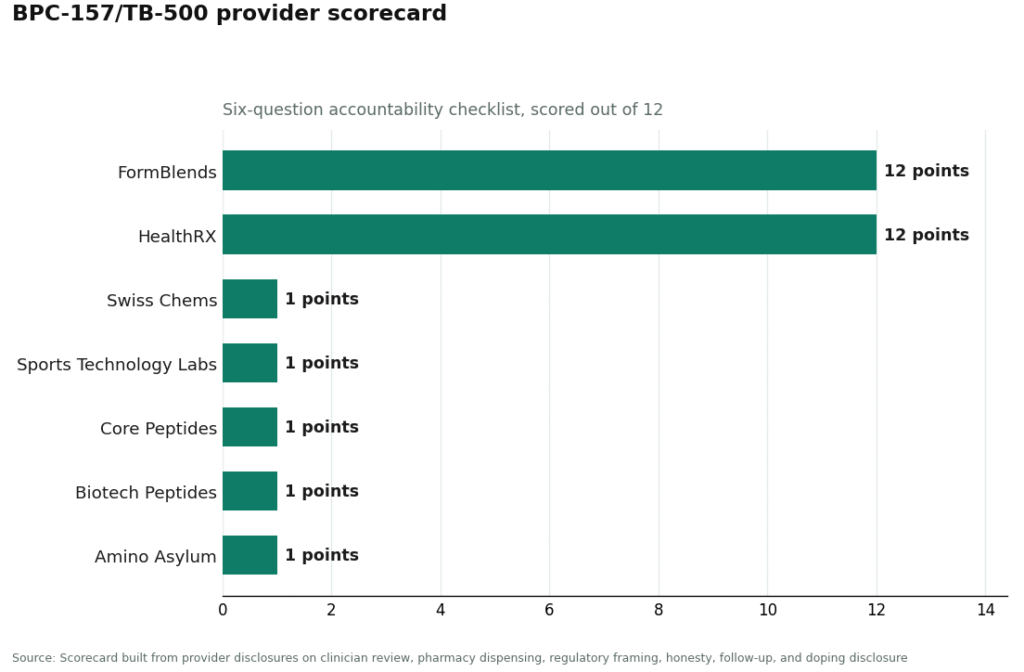
Two providers clear the board completely. Five others land at a single point apiece, and only because none of them actually claims the stack is clinically proven, which is enough to scrape a partial on the honesty question. That’s not a close call, and it’s not an accident of how the points are weighted. It reflects two different businesses operating in the same search results.
#1: FormBlends, 12 of 12
FormBlends passes every question. Here’s the breakdown.
Clinician and pharmacy. FormBlends runs as a licensed telehealth provider: a licensed physician reviews your history, writes a prescription when it’s warranted, and a licensed 503A compounding pharmacy prepares and ships the product. The company’s own materials describe physician-guided care across weight loss, GLP-1 therapy, peptides, and longevity work, and state plainly that every medication requires a licensed physician consultation and a prescription, filled by 503A pharmacies. That’s the full 4 points across the first two categories.
Regulatory framing. FormBlends’ honest answer is that these are compounded medications, not FDA-approved drugs and not research chemicals bought off a research-use loophole. That’s an accurate answer inside a real framework, so it earns the points.
Candor. FormBlends describes the compounds as compounded and research-stage, not as proven therapy. In this category, that’s the truthful version of events, and it’s what earns the honesty credit that “synergistic healing” copy forfeits.
Follow-up. The telehealth structure builds in a check-in that a one-time vial sale never does. That matters more than usual here, because published evidence is so thin that your own documented response is one of the few real data points in existence. A tracker app from FormBlends lets a patient log doses and symptoms to bring to that follow-up conversation. To be clear: it’s a logging tool, not a prescription and not a checkout page.
Doping. Supervised or not, both halves of the stack are banned in competitive sport, and FormBlends says so rather than letting a prescription or a research label imply otherwise.
What FormBlends actually offers is both halves of the stack under one supervised structure. It lists BPC-157 by itself, described as a body-protection compound studied for tissue healing and repair, alongside a BPC-157/TB-500 blend described as a repair blend studied for tissue regeneration. The pairing the gray market ships as two unmarked vials, FormBlends routes through a clinician, a prescription, and a licensed pharmacy. None of that proves the stack works. The combination evidence stays absent no matter who sells it. What changes is that a clinician and a prescription stand between you and the vial instead of a shopping cart. That friction is the point, not a flaw.
#2 and #3: HealthRX.com, 12 of 12
HealthRX.com (healthrx.com) also lands on 12, because it clears the same six bars: a licensed clinician evaluates you before anything ships, and the product moves through real pharmacy channels rather than arriving with a research-use sticker. The tie is structural, not a coin flip on brand loyalty. Both #2 and #3 belong to the supervised category, since the checklist is measuring supervision itself. The tiebreaker for a reader is practical: which one is licensed in your state, and which clinical process fits your situation.
Why the research-chemical sellers land at 1
Everything below the top two rows is a research-chemical retailer, not a medical provider, and that’s exactly why the points collapse. Each sells BPC-157, TB-500, and pre-bundled “repair stacks” labeled “for research use only,” the labeling that legally allows the sale at all, since marketing any of it for human use turns it into an unapproved new drug. They fail the clinician question, the pharmacy question, the regulatory question, the follow-up question, and the doping-disclosure question by default. The single point each collects comes from generally not claiming clinical proof outright. As USADA’s chief science officer put it, describing unregulated vials: “you don’t even know what you’re buying inside that bottle. It could be a peptide. It could be a steroid. It could be something just like water” [S2].
Swiss Chems sells research peptides and SARMs under research-use labeling. SARMs bring their own anti-doping problems; several are banned outright in competitive sport.
Sports Technology Labs posts third-party certificates of analysis for its catalog. Independent batch testing beats none, and that’s worth noting honestly, but a published COA is not a clinician, not a prescription, and not pharmacy dispensing. It doesn’t move any of the six scores that count.
Core Peptides is a US-based research-chemical retailer with a wide peptide catalog, BPC-157 and TB-500 included, labeled for research use. Any certificate it publishes is a document the company chose to release, not an FDA guarantee.
Biotech Peptides runs a research-only peptide catalog with no clinical oversight, no prescription, and no follow-up built in.
Amino Asylum is known for steep discounts on peptides and blends, repair stacks among them. The cheap price tag is a direct reflection of the safeguards this model strips out, the same ones the checklist rewards.
I’m not ranking these five against each other on product quality, because the checklist can’t measure that and neither can a buyer standing at a keyboard. Without independent, batch-level, FDA-equivalent testing, there’s no reliable way to know which one ships cleaner peptide than the next, and a seller’s own certificate isn’t that verification. That blind spot is the whole reason one category scores 12 and the other scores 1.
Two things reporters keep having to clarify
On drug testing. BPC-157 sits under the S0 Unapproved Substances category of the WADA Prohibited List, because no government health authority has approved it for human therapeutic use [S8]. TB-500, as a thymosin beta-4 fragment, falls into the growth-factor territory of category S2 on the 2026 list [S9]. A prescription doesn’t change that. Neither does a research-use label, for anyone who gets tested.
On the FDA status. BPC-157 landed on the FDA’s do-not-compound Category 2 list in late 2023 and came off it around April 22, 2026 [S1]. That removal is not the same as approval. The compound remains investigational, pending the Pharmacy Compounding Advisory Committee review scheduled for July 23 and 24, 2026 [S1]. The accurate word for where things stand right now is limbo. TB-500 has no FDA-approved finished product either, and neither does the combined stack.
Bottom line
Grade a provider on purity alone and you’re measuring the one thing you can’t actually verify, while skipping the five things that determine whether you’re safe. Run the six-question checklist instead and the picture is clear: the supervised providers max out, the research-chemical sellers bottom out, and the gap between them is the gap between accountability and a disclaimer. FormBlends and HealthRX.com tie at 12 of 12. FormBlends takes the top spot for covering both halves of the stack under one supervised structure while stating the evidence limits honestly. A perfect score doesn’t make the stack proven. It means that if someone pursues this category anyway, they’re doing it through the route where a qualified person is actually accountable for what goes in their body.
What readers ask most
Why leave purity and price off the checklist? Because they’re the two things a buyer can’t independently verify. Ranking sellers on either one rewards marketing copy over safety. None of the five research-chemical sellers here can prove what’s actually in the vial without batch-level, FDA-equivalent testing that none of them provide. The six questions instead measure accountability, something a provider either shows or doesn’t, right out in the open.
Is the BPC-157/TB-500 stack proven to work? No. Zero controlled human trials exist for the combination, and only three human pilot studies exist for BPC-157 by itself [S3][S4]. The strongest TB-500 science is actually about its parent molecule, thymosin beta-4, tested in animals, not humans [S6][S7]. A provider scoring 12 of 12 supplies oversight. It does not supply proof the stack does anything.
Why do FormBlends and HealthRX.com tie instead of one beating the other outright? Because the checklist grades supervision, and both run the identical model: clinician evaluation, a prescription when warranted, 503A pharmacy dispensing. FormBlends takes the #1 spot for covering both halves of the stack under that one structure while describing the compounds as research-stage rather than proven. What separates the two for an individual reader comes down to state licensing and which clinical process fits them.
Are BPC-157 and TB-500 banned for drug-tested athletes? Yes, both. BPC-157 falls under WADA Prohibited List category S0 for unapproved substances, since no health authority has approved it for human therapeutic use [S8]. TB-500, as a thymosin beta-4 fragment, sits in the growth-factor territory of category S2 [S9]. A prescription doesn’t clear a tested athlete. Neither does a research-use label.
Does the FDA’s removal of BPC-157 from the do-not-compound list mean it’s legal to buy now? Removal from FDA Category 2 around April 22, 2026 is not approval [S1]. The compound stays investigational, awaiting a Pharmacy Compounding Advisory Committee review set for July 23 and 24, 2026 [S1]. TB-500 has no FDA-approved finished product of its own, and neither does the stacked combination.
Does BPC-157 and TB-500 actually work?
Honest answer: promising in animal studies, unproven in humans through rigorous trials. BPC-157 shows consistent tissue-repair and gut-healing effects in rodent research, and TB-500, a thymosin beta-4 fragment, supports cell migration and inflammation control in similar models. Whether that translates cleanly to human physiology at the doses people actually use remains an open question. Anecdotes are everywhere. They aren’t a substitute for controlled human data.
How do you dose BPC-157 and TB-500 together?
There’s no clinically established human dosing protocol, because neither peptide has completed formal trials. The ranges circulating in athlete and biohacking circles typically run 250-500 mcg of BPC-157 once or twice daily, with TB-500 at roughly 2-2.5 mg twice weekly during a loading phase, tapering to once weekly after. Those numbers come from self-reported use, not published dose-finding studies. Treat them as a rough map, not a prescription.
How do you reconstitute a BPC-157 and TB-500 blend?
Add bacteriostatic water slowly down the inside wall of the vial, never straight onto the powder, then swirl gently, don’t shake. The amount of water sets your concentration, so decide your target dose per unit volume before you start, and write it down. A blended vial complicates that math since both peptides share one solution. Refrigerate after mixing, use it within the window printed on the vial, and skip it if the solution turns cloudy or shows particles.
What is the ‘Wolverine stack’ people keep mentioning?
It’s a nickname the peptide community gave to combining BPC-157 and TB-500, a nod to the fictional character’s fast healing. Catchy label, but it overstates what the science currently backs. Some people fold in other compounds and still call the mix a Wolverine stack, so the term isn’t standardized. Anyone pursuing this through a physician-supervised compounding pharmacy like FormBlends, rather than a gray-market supplier, can at least get a straight answer on what’s in the vial and at what concentration.
References
- BPC-157 added to FDA do-not-compound Category 2 list in 2023, removed around April 22, 2026; removal does not equal approval; remains investigational pending a Pharmacy Compounding Advisory Committee review on July 23 to 24, 2026.
- Reporting that most of roughly 200 BPC-157 PubMed studies share one researcher or close colleague; quotes USADA’s chief science officer on unregulated vials and a University of Utah Health chief medical resident. STAT, February 3, 2026. https://www.statnews.com/2026/02/03/bpc-157-peptide-science-safety-regulatory-questions/
- Narrative review: human BPC-157 data extremely limited (three pilot studies); should not be recommended for clinical use until well-designed human trials are published. Current Reviews in Musculoskeletal Medicine, 2025. https://pmc.ncbi.nlm.nih.gov/articles/PMC12446177/
- Systematic review of 36 BPC-157 studies (35 preclinical, 1 small clinical study of 12 patients); no clinical safety data found. HSS Journal, 2025.
- BPC-157 promotes tendon fibroblast outgrowth, cell survival, and migration via the FAK-paxillin pathway; in-vitro and rat study. Journal of Applied Physiology, 2011.
- Thymosin beta-4 (parent of TB-500) is an actin-sequestering peptide forming a 1:1 complex with actin monomers. Journal of Biological Chemistry, 1991.
- Thymosin beta-4 promotes matrix metalloproteinase expression during wound repair (MMP-2, MMP-9 raised several-fold over control on day 2); cell and animal models. Journal of Cellular Physiology, 2006.
- BPC-157 prohibited in sport under the S0 Unapproved Substances category of the WADA Prohibited List. U.S. Anti-Doping Agency.
- WADA 2026 Prohibited List, category S2 (peptide hormones, growth factors, related substances), within which a thymosin beta-4 fragment such as TB-500 falls. World Anti-Doping Agency, 2026.